India’s $2-Trillion Export Roadmap Begins: What Businesses Should Track Before Opportunities Open Up
- Devyani
- 4 months ago
- 3 minutes read
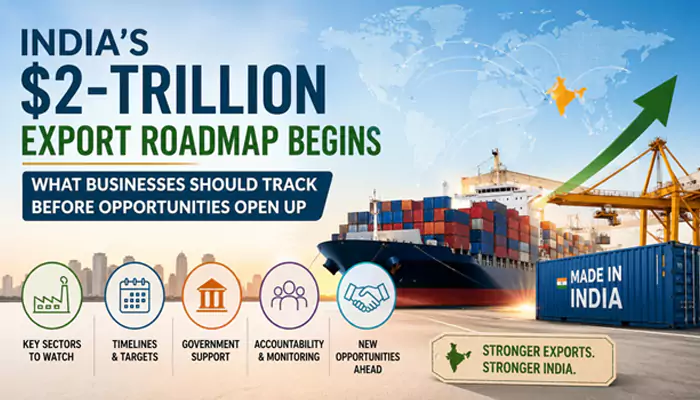
A new export monitoring framework puts sectors, timelines and accountability at the centre. For businesses, the message is simple: watch where the government is building support next.
India’s export ambition has acquired a more practical shape. Commerce and Industry Minister Piyush Goyal has said India is targeting $2 trillion in total exports by 2030–31, split equally between $1 trillion in merchandise exports and $1 trillion in services exports. The new part is not the ambition alone. It is the machinery being built around it.
The Department of Commerce has prepared a structured Export Monitoring Framework that breaks the national target into sector-wise actions across engineering goods, textiles, electronics, pharmaceuticals, chemicals and services. Each action is expected to be tied to timelines, key performance indicators and assigned nodal officers. In plain business language: someone will be answerable for each moving part.
Why The Push Is Happening Now
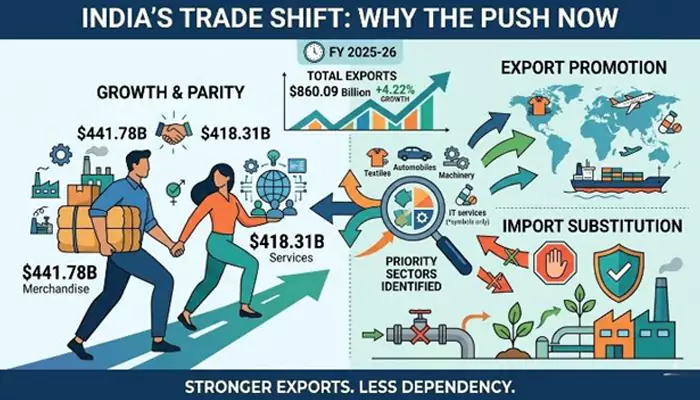
The timing matters. India’s total exports in FY 2025–26 are estimated at $860.09 billion, up 4.22% from the previous year. Merchandise exports stood at $441.78 billion, while services exports reached $418.31 billion. That means services are no longer the quiet cousin in India’s export story; they are almost shoulder-to-shoulder with goods.
The government’s plan also asks officials to identify priority sectors where import substitution can move along with export promotion. That is the interesting twist. India is not only asking, “What can we sell abroad?” It is also asking, “What should we stop depending on others for?”
What Businesses Should Track
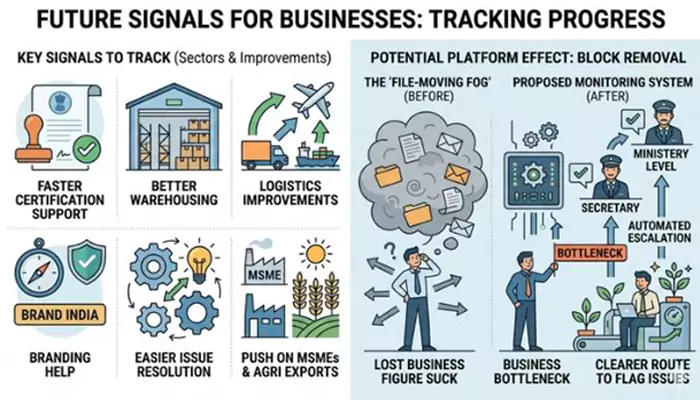
For exporters, MSMEs and even smaller manufacturers, the next signals will matter more than the headline number. Businesses should watch which sectors get faster certification support, better warehousing, logistics improvements, branding help and easier issue resolution. Goyal has also called for a bigger push on Brand India, along with sharper attention to MSMEs and agricultural exports.
The most useful development could be the proposed IT-enabled monitoring platform, with automated escalation to the Secretary and Minister levels. If it works well, exporters may get a clearer route to flag bottlenecks instead of getting stuck in the usual file-moving fog.
The Stand-Out Angle: Treat This Like A Public Procurement Calendar
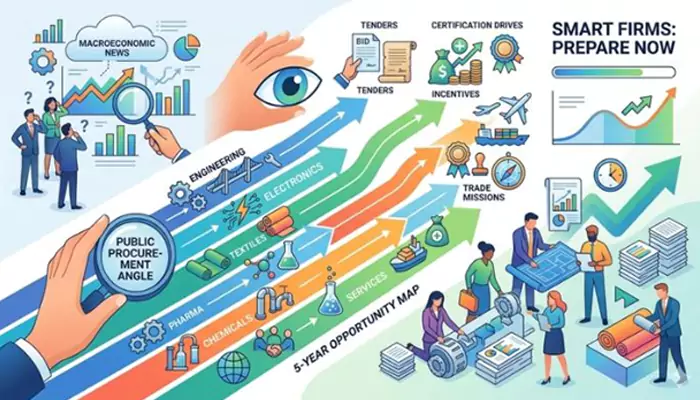
Here is the overlooked bit. Businesses should not treat this as only a macroeconomic announcement. They should read it like a five-year opportunity map. If engineering goods, electronics, textiles, pharma, chemicals and services are being tracked sector by sector, then tenders, incentives, certification drives and trade missions may follow the same lanes. Smart firms should start aligning products, documentation and market research now, not after the scheme details become crowded.
India’s $2-trillion export goal will be judged less by speeches and more by execution. For businesses, the next move is to track sector-specific support, prepare compliance papers early, and spot where policy momentum is gathering.
.webp)
.webp)
.webp)
.webp)