386 Constituencies, One Day: Mapping Bengal’s Phase I and Tamil Nadu’s Full-Scale Vote
- Devyani
- 1 day ago
- 3 minutes read
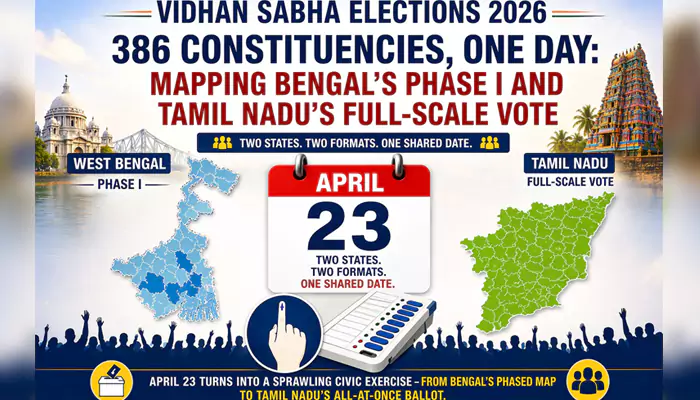
Two states. Two formats. One shared date. April 23 turns into a sprawling civic exercise - from Bengal’s phased map to Tamil Nadu’s all-at-once ballot.
It’s a peculiar symmetry, if you pause and look closely.
On one side, West Bengal begins its electoral journey in fragments - Phase I, covering 152 constituencies. On the other hand, Tamil Nadu goes all in, all at once - 234 constituencies voting in a single sweep. Same date. Entirely different rhythms.
And yet, the morning looks similar in both places. Polling booths open at 7 AM. Lines form. Someone checks their ID twice. Someone else forgets a pen they don’t even need.
Two Maps, Two Speeds
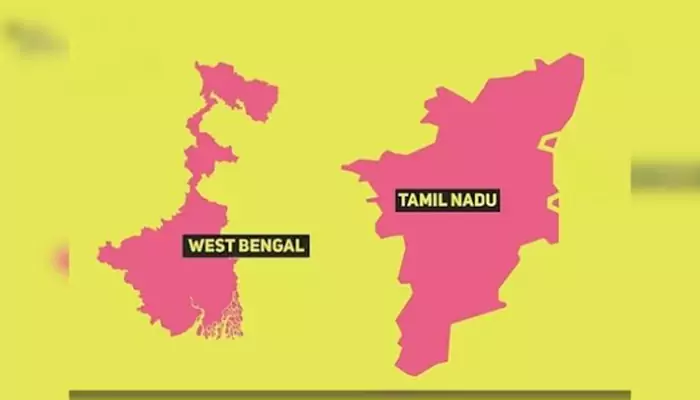
West Bengal’s election is staggered by design. Today’s Phase I spans 152 of its 294 seats, spread across 16 districts, with roughly 3.6 crore voters stepping out to participate.
Tamil Nadu, though - no stagger, no second act. All 234 seats vote today, with over 5.73 crore voters and 4,023 candidates in play. It’s less a phase and more a full stop.
Put together, you’re looking at nearly 12 crore people voting on a single day across two very different electoral formats. That number doesn’t sit quietly. It hums.
The Quiet Mechanics of a Loud Exercise
Despite the scale, the process itself feels almost repetitive - intentionally so.
Verification. Ink. Button. Done.
Whether you’re in a booth tucked inside a school in North Bengal or a community hall in Chennai, the choreography doesn’t change much. The EVM-VVPAT system runs the show, quietly recording choices, one press at a time.
Scale, But Make It Personal
Big numbers tend to blur. 5.73 crore. 3.6 crore. 386 constituencies combined today.
But zoom in, and it’s just people.
A first-time voter rehearsing the process in their head. An elderly voter insisting on standing in line without help. A polling officer flipping through registers, page after page, like it’s any other workday - except it isn’t.
And maybe that’s the paradox. Elections are enormous, but they run on very small, human moments.
Why This Contrast Matters
Bengal’s phased voting spreads administrative load - security, personnel, logistics - over multiple days. Tamil Nadu compresses all of it into one intense window.
Together, these parallel voting models show how large-scale elections can be executed using different logistical strategies, while maintaining uniform procedures, ensuring accessibility, and managing participation efficiently across diverse regions on the same day.