Union Budget 2026-27 : Biopharma SHAKTI - Can a ₹10,000 Crore Injection Turn India into a Drug Discovery Hub?
- Devyani
- 6 months ago
- 3 minutes read

For decades, we’ve been the world’s favorite chemist - reliable, cheap, and always open. But with a new ₹10,000 crore bet, the Finance Minister wants us to stop just mixing the medicines and start inventing them.
If you walk into a pharmacy in Kenya, Kansas, or Kolkata, chances are the pill in your hand was made in India. We wear the "Pharmacy of the World" badge with pride, and rightly so. But here is the uncomfortable truth we don't talk about at dinner parties: we are masters of the copy. We reverse-engineer better than anyone, but when it comes to creating the original molecule? We are barely on the map.
Yesterday, the Finance Minister tried to change that narrative.
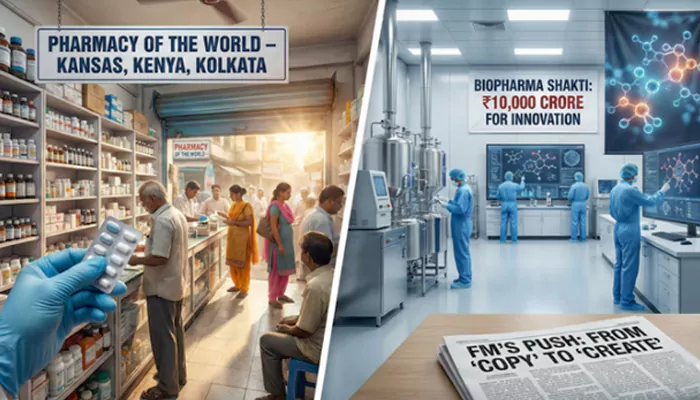
The announcement of Biopharma SHAKTI isn't just another line item in a dense budget speech. It’s an admission that the "volume game" (selling cheap generics) has a ceiling. With a ₹10,000 crore injection over five years, the government is finally trying to push the industry up the value chain - from simple chemical pills to complex biologics and biosimilars.
Why "SHAKTI" Matters (And Why Now)
Let’s be real - ₹10,000 crore ($1.2 billion roughly) is what a global giant like Pfizer or Roche might spend on R&D in a single year. So, is this amount just a drop in the ocean?
Perhaps. But it’s a strategic drop.
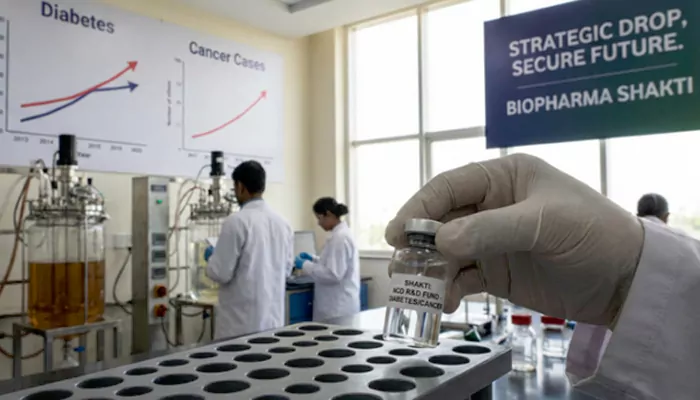
The focus here is laser-sharp:
Non-Communicable Diseases (NCDs). We are seeing a tidal wave of diabetes, cancer, and autoimmune disorders in India. Treating these with imported biologics burns a hole in our pockets. By funding domestic production of these high-value drugs, the government is trying to kill two birds with one stone: secure our health security and kickstart a high-tech industry.
The "Plumbing" Problem
What excited me most wasn't the cash, but the "plumbing" fixes. You can throw money at scientists, but if they can't test their drugs, it’s useless.

The proposal to set up a network of 1,000 accredited clinical trial sites is the sleeper hit of this budget. For years, Indian clinical data has been viewed with skepticism globally. Standardizing these sites is like getting an ISO certification for our scientific integrity. If we can prove our data is clean, the world will come here not just to manufacture, but to research.
Add to that the plan for three new NIPERs (National Institutes of Pharmaceutical Education and Research) and upgrading seven others. It seems we are finally realizing that you can't build a biotech hub without a pipeline of specialized talent. You can't run a Ferrari on a cycle track.
The Regulatory Elephant in the Room

However, money is the easy part. The hard part? Bureaucracy.
The budget acknowledges this by promising to overhaul the Central Drugs Standard Control Organisation (CDSCO) with a dedicated "scientific review cadre." This is crucial. In the past, innovative files often gathered dust because the regulators simply didn't have the technical expertise to evaluate complex biologics. If this "scientific cadre" is real and empowered, it could cut approval timelines by half. That’s a big "if," but it’s a start.
Biopharma SHAKTI is not a magic wand. It won't turn Hyderabad into Boston overnight. But it’s a signal that the government is willing to share the risk of innovation. For an industry that has been risk-averse for decades, content with the steady profits of generics, this might be the nudge it needs.
We have spent 30 years being the world’s factory. It’s about time we became its laboratory.

.webp)
.webp)
.webp)
.webp)