Remembering Einstein: The Forgotten, Zero-Electricity Refrigerator He Invented to Save Everyday Lives
- Soham Halder
- 4 months ago
- 3 minutes read
You know the wild hair and the famous equation. But his greatest gift to everyday survival didn't even use a single watt of power.
Sometime in the winter of 1926, reading the morning newspaper was a genuinely grim exercise in Berlin. A local family, sleeping soundly, was wiped out overnight. The culprit wasn't a burglar. It was their own kitchen appliance.
Early mechanical refrigerators were essentially ticking time bombs. They used highly toxic coolant gases like sulfur dioxide or methyl chloride. If a mechanical seal broke in the middle of the night, the results were fatal.
Albert Einstein read about this specific tragedy. And he got angry.
He didn't just shake his head and turn the page; he called up his former student, a brilliant physicist named Leo Szilard. They decided the current cooling technology was fundamentally broken. It relied on motorized compressors and fragile seals that inevitably degraded. So, they stripped the concept down to the studs.
Cooling with Fire
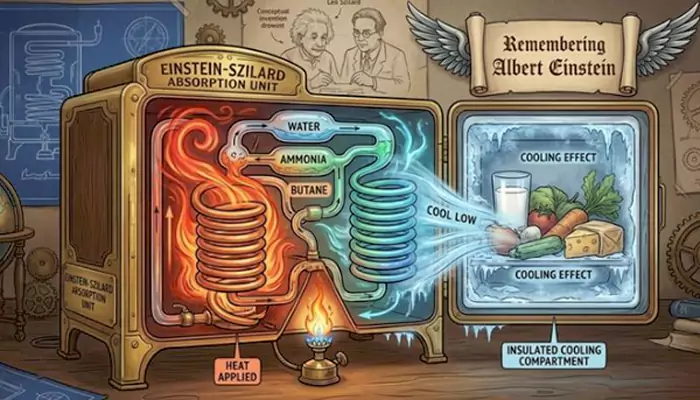
Here is the kicker. Their proposed solution didn't require plugging anything into a wall.
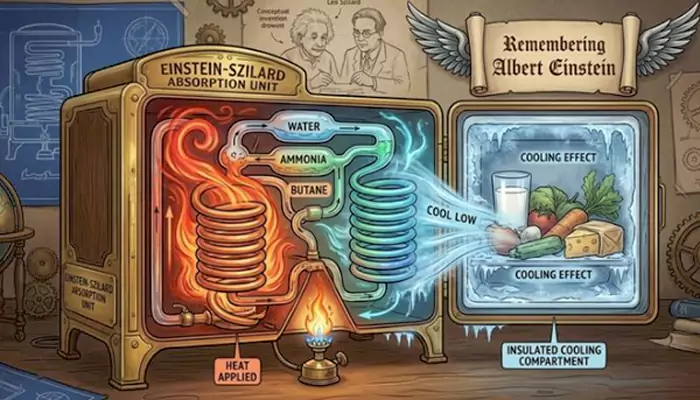
The Einstein-Szilard refrigerator operated entirely on an absorption cycle. It used a specific, pressurized cocktail of three liquids: water, ammonia, and butane. That is it. No moving parts. No mechanical wear and tear. No seals to break and leak poison into your hallway.
To make it work, you just applied a small heat source - literally a tiny gas flame - at one end. The heat triggered a chemical reaction that forced the butane to evaporate, drawing heat out of the insulated box.
It cooled your food by heating up the plumbing. Absolutely brilliant.
Buried by "Progress"
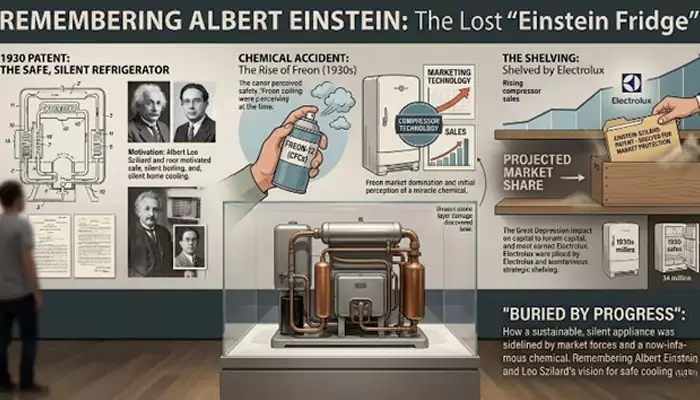
So, why aren't we all staring into an Einstein fridge at 2 AM while deciding if we want leftover takeout?
History has a funny way of burying genuinely good ideas. Right around the time they patented this silent, bulletproof machine in 1930, the American chemical industry introduced Freon. At the time, Freon seemed like a miracle. It was non-toxic to breathe - though, oops, we’d later figure out it was aggressively tearing a hole in the ozone layer.
Freon won the market war. Then the Great Depression hit, wiping out capital for weird new inventions. The Swedish appliance giant Electrolux actually bought the Einstein-Szilard patent, but mostly just to shelve it and protect their own compressor-based market share.
A Century Later
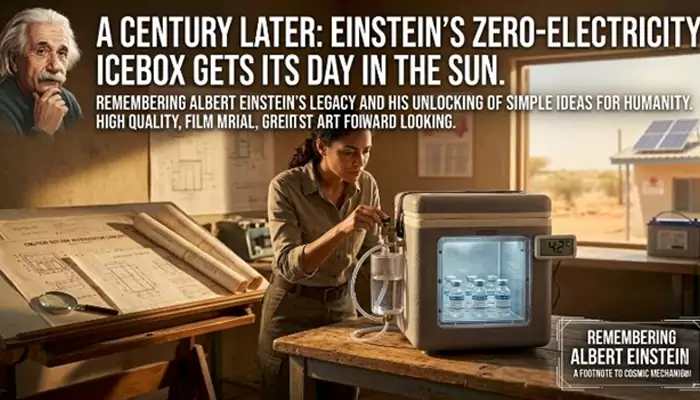
It feels like a massive, collective missed opportunity. Yet, it seems the blueprints aren't completely dead.
Today, researchers are actually dusting off these old patents. Engineers at places like Oxford are trying to adapt the zero-electricity design to keep vaccines cold in off-grid rural areas where stable power is just a rumor.
It’s a strange, quiet footnote to a massive legacy. The man who unlocked the raw mechanics of the cosmos also just wanted to stop our groceries from killing us.
And maybe, a century later, his forgotten icebox will finally get its day in the sun.