
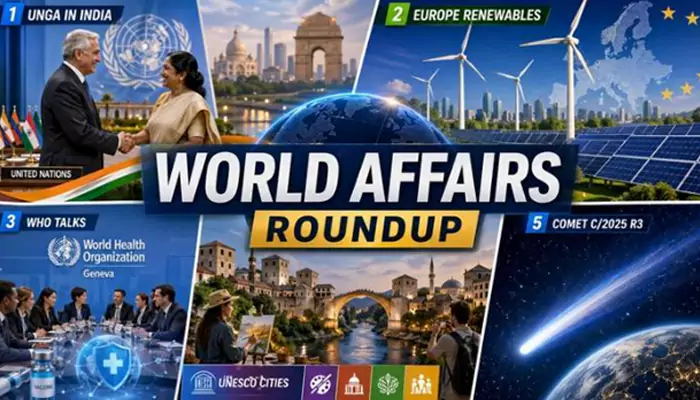
Here are today’s top news updates from around the world.
UNGA President to Visit India for Multilateral Talks
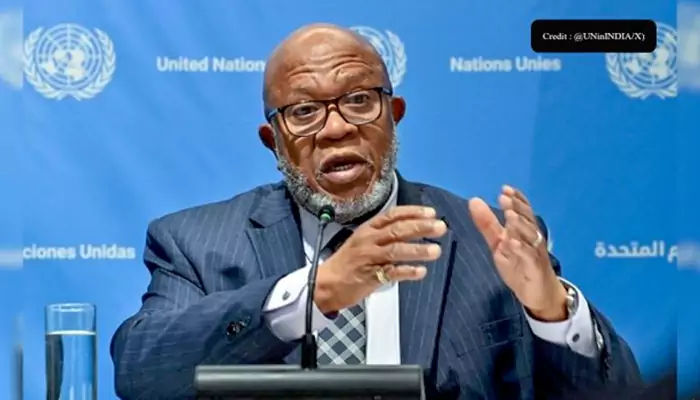
The visit will place India’s role in global cooperation, AI governance and UN engagement in focus.
United Nations General Assembly President Annalena Baerbock is set to visit India this week, with a day-long programme planned in New Delhi on 28 April. The visit is being positioned around stronger multilateral cooperation at a time when countries are looking for practical ways to work together on global challenges. Baerbock is scheduled to meet External Affairs Minister Dr. S. Jaishankar for bilateral talks. She will also engage with India’s Ministry of Electronics and Information Technology to understand the country’s approach to AI regulation and governance. Her schedule includes a meeting with the UN Country Team, a press conference at UN House, and a visit to a UNESCO World Heritage Site before she travels onward to China.
Europe Turns Back to Renewables as Power Costs Stay in Focus
Countries with a higher renewables output have been protected from steep rises in electricity prices since the United States and Israel attacked Iran, price comparisons from across Europe show. That could help households, businesses and growth in those countries as the price…
— Reuters (@Reuters) April 27, 2026
(@Reuters/X)
Renewable energy is again taking centre stage as European countries look for steadier power options.
Across Europe, renewable energy is getting renewed attention as countries deal with higher and more volatile power costs. A Reuters report says nations with stronger renewable or non-fossil power systems have seen more protection from sharp wholesale electricity swings.
Albania, where hydropower supplies more than 90% of electricity output, has been cited as one example. Spain, with renewable generation close to 60% of total output, has also shown a steadier price picture. In comparison, gas-reliant markets such as Italy and Germany have seen sharper benchmark price increases. The broader takeaway is fairly simple: countries with a wider clean-energy base may have more room to manage price pressure, while Europe keeps looking for long-term grid stability.
WHO Pandemic Agreement Talks Resume in Geneva
As we approach the 79th World Health Assembly, the the Sixth Intergovernmental Working Group (IGWG) on the WHO Pandemic Agreement is meeting this week to continue discussions on the pathogen access and benefit sharing system (PABS) annex.
— World Health Organization (WHO) (@WHO) March 23, 2026
The PABS Annex will operationalize key…
(@WHO/X)
Countries are continuing talks on future pandemic preparedness and fair access to health tools.
Talks on the WHO Pandemic Agreement resumed today in Geneva, with member states meeting from 27 April to 1 May in hybrid format. The focus is the Pathogen Access and Benefit Sharing, or PABS, annex. In plain terms, this is about how countries can safely share pathogen materials and sequence information, while also ensuring fair access to benefits such as vaccines, diagnostics and treatments. The agreement itself was adopted by the World Health Assembly in May 2025, but the PABS annex still needs to be finalized. The outcome of this week’s negotiations is expected to go to the 79th World Health Assembly in May 2026 for consideration.
UNESCO Cities Meet to Link Heritage, Creativity and Tourism
🏙️UNESCO Creative & #World Heritage Cities🌍
— UNESCO Venice Office (@UNESCOVenice) April 24, 2026
🇪🇺 Within @cc4wbs, @unesco & the City of Mostar host a sub-regional conference on sustainable cultural tourism, connecting creativity & heritage for stronger cities. 🏛️🤝
📅27-28 April📍#Mostar 🇧🇦
➡️https://t.co/spE4cHLJ5b pic.twitter.com/lPkNENkDx7
(@UNESCOVenice/X)
World Heritage and Creative Cities are discussing how culture can support better tourism planning.
UNESCO’s conference on Creative and World Heritage Cities opened today in Mostar, Bosnia and Herzegovina, bringing together city representatives and cultural experts for a focused discussion on sustainable tourism. The event looks at how creativity and heritage can work together, not as separate labels, but as practical tools for urban planning.
According to UNESCO, the meeting brings in Creative Cities and World Heritage Cities from parts of South-East Europe, along with European counterparts from Italy and the United Kingdom. The agenda includes tourism pressure, climate-related challenges, governance and digital tools. The larger message is neat: cities can protect heritage while still making tourism more thoughtful, organised and locally useful.
Comet C/2025 R3 Makes Its Closest Approach to Earth
https://www.instagram.com/p/DXn1TTQjB7x/?igsh=ZGs2dmZib2lxdjUz
(@howtoastro/Instagram)
Skywatchers have a fresh reason to look up as a bright comet passes near Earth.
Comet C/2025 R3 makes its closest approach to Earth today, according to NASA’s April skywatching guide. The comet is expected to come within about 44 million miles of our planet. NASA says some observers believe it could be among the brighter comets of the year, though not bright enough for easy naked-eye viewing. It is likely to reach around magnitude eight, meaning binoculars or a telescope would be needed. For Northern Hemisphere viewers, the comet has been visible in the predawn sky from mid-April through the end of the month, near Pegasus and above Pisces. A small sky show, yes, but a rather graceful one.

.webp)


